javascript:void(0) images move me

Sunday, August 17, 2014

Hot Southerners


I am sitting in my upstairs apartment in the dead of summer in Florida.  At 11:30 at night, it is still 85 degrees outside.  My apartment is roughly 2 degrees warmer.  The ceiling fan whirs and I keep the lighting to a minimum.  Sitting on the little sun porch, I am illuminated only by my computer screen and the string of star twinkle lights I affixed to the wall.  This affords just enough light for me to see the beads of sweat on my chest and arms.  I feel the trickles drip down my skin between my breasts, as my blousy, sleeveless nightgown does nothing to absorb any of the perspiration.  I refrain from using my window air conditioner.  It wouldn’t reach the sun porch, anyway.  I like the heat.  I am in my personal steam room.  Mostly, though, I feel like I’m in a southern, old-timey movie where the characters live forever lubricated.  It looks sexy on screen, but I’m really just a sweaty mess, drinking my cold beer and shifting in my seat so as not to stick to the chair.

I love movies set in the South.  I feel like the characters are stronger somehow, subconsciously working to assert themselves when they have the legacy of slavery and stupidity to deal with.  I love when the farm daughters, as in Man In the Moon, sleep on the windy porch during the summer months just to get some relief from the weighted, hot nights.  The sisters talk to each other well into the night, just like girls always do during sleep overs—whatever age they may be.  I love when, in A Time to Kill, Matthew McConaughey’s character comes home from lawyering all day to find his hot and sticky wife, Ashley Judd, scraping at the floor of their big fixer-upper farmhouse.  No, they never would simply come home and veg out in front of the t.v. They have work to do, after all.  And no fans or air conditioners in sight. No sir.  They are down and dirty and sweaty southerners.  They are hot.

Come to think of it, Ashley Judd is really a staple of southern, sweaty characters in movies.  In Divine Secrets of the Ya Ya Sisterhood (which is a really good book but a terrible movie…i.e. fantastic guilty pleasure movie…with lots of drippy Southern accents and nostalgia for drunk moms and superb summer swimming holes), Judd and her friends hang out in an upstairs room of a beautiful plantation house in their skivvies, complaining with buttery southern drawls how hot and sweaty they are. Now that I actually live in an upstairs room in the South, I completely understand their malaise on a whole new level.  I, too, play my record player while I lie on the bed, praying for someone to “wring me out.”

Why this love? Why this infatuation with the stinky, sweaty, southern characters?  I guess I just feel more alive when my body’s working overtime to compensate for this spike in temperature.  I spend lots of (too much) time in my head.  Feeling feverish in my body reminds me I am more than just my thoughts.  My body is mine, too.  It’s here; it’s hot; so am I.


Sunday, July 6, 2014

Maleficent

The best way to approach life is how I approached seeing Maleficent:  sans expectations.  Sleeping Beauty was one of my favorite Disney movies as a child.  It was not due to the storyline of Sleeping Beauty (a.k.a. Aurora) herself.  She is a typical blonde princess who, due to a curse, pricks her finger on a spinning wheel, falls into a deep sleep, and needs a prince to rescue her.  Yawn.  Instead, I liked the little trio of guardian fairies, but the woman whom I loved most of all?  Maleficent, of course.  In the cartoon, she was intriguing in that charismatic and terrifying way that the best villains are. 

In the live-action version, Angelina Jolie as Maleficent does not disappoint.  In fact, she is downright fierce.  Those horns.  That smirk.  The cape.  The storyline is simple.  We follow Maleficent from a naïve girl to a brutal woman.  The scenery is stunning, a superb fantasy fairy forest.  I admit, I’m a sucker for anything with wings.  And, Maleficent’s got them—until she doesn’t.

SPOILER:  Maleficent gets her wings chopped off.  We do not see the act—which makes it all the more heinous in one’s imagination.  When Maleficent awakes, she cries out with an animalistic howl; she is sore; she is broken.  Rapes can take different forms.  For example, in Toni Morrison’s Beloved, a character is raped by men who suck milk from her breast.  She is violated.  She is harmed.  The same sort of rape occurs here for Maleficent, which serves to explain to a degree her need for vengeance and her distrust for the world. 

Throughout the film, we see Maleficent soften and reconcile her station and the consequences of that violent act.  She is, after all, able to overcome her sorrow and open her heart again—this time, to a young woman.

For that, Maleficent, the movie, turns feminist and woman-supporting in a cruel “man’s world.”  Yes, princesses still exist, but that seems beside the point.  The women here support each other and rescue themselves.  Maybe, just maybe, some young girls will understand the importance of self-salvation and how a prince will never save you.  That’s your own job, after all. 

Sunday, June 8, 2014

"Comfort Food" Movies


Comfort food, to me, is usually starchy and cheesy and salty and filling.  It's familiar and satisfying.  Sometimes, movies can also serve as comfort food.  

I recently moved to a new town.  My work hours are very long, and I decided that it just was not worth the trouble or money to get cable, or t.v. for that matter.  I am tired when I come home.  I need to unwind.  I need mind-numbing, but familiar love.  I don't have a roommate or a boyfriend.  What I do have, though, are a revolving number of movies that give me pleasure.  And, no, I'm not talking about porn.  I mean that these movies are like old friends to me.  The stories are usually simple and do not involve suspense or thrill.  They are light dramas--the kind I would never encourage anyone to pay $12 at the movie theater to see.  No, these are movies that you must buy.  They are in the $5 bin at Walmart.  They have been overlooked by the masses, yet embraced by the love-lorn.  They are friends; as such, I will defend them with my very being.  Dramatic?  Yes, but they have gotten me through lonely Saturday nights and terribly exhaustive work days.  

I am always learning about new movies, mind you.  However, this is a list of my current sweethearts:

It's Complicated
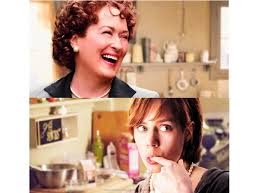
Julie and Julia
Walking and Talking
Something's Gotta Give
This Is My Life
Before Sunset

The movies change, depending on the new town in which I am living and my mood.  Usually, though, the list shifts between such directors as Nicole Holofcener (Lovely and Amazing, Walking and Talking) and Nora Ephron (Julie and Julia and This Is My Life), who typically sets her characters in an atmosphere of a grittier, more real New York City.  Of course, when I need beautiful scenery and rich serenity, I turn to Nancy Meyers (It's Complicated).  

In order to be a "comfort food" movie, you must be able to turn it on at any point in the course of the plot and continue watching until the end.  You must identify at least one character as a potential best friend.  You must never be able to recommend that others see this movie in a theater.  Most importantly, you must only watch this movie in pants that have an elastic waist while you wallow on your couch while eating ice cream or macaroni and cheese.  Alone.  

Go ahead and make your own movie friends.  They can shuttle you through loneliness or simply keep you company.  They are besties without expectations.  They are givers and ask nothing in return.  We all need that sometimes.

Sunday, December 29, 2013

Inside Llewyn Davis

Inside Llewyn Davis is a story about a folk singer in 1961.  He's talented and soulful, but he has not reached a level of fame or fortune.  There could be lots of reasons for this:  maybe, talent doesn't necessarily get recognized by the masses; he doesn't sell out his personality and trade it in for a sweet one to make himself appealing to everyone. Whatever the reason, this guy isn't making it big, and I never necessarily felt sorry for him--which actually made this an appealing movie for me.

This is the kind of movie where nothing significant really happens, but we, as the audience, are allowed a glimpse into this guy's life.  He is a writer and a singer.  He's real.  Consequently, he has a lyrical soul.  Lewynn has a presence about him that's both humble and arrogant.  Humble because he basically is broke and living on people's couches.  Arrogant because he knows he should be successful.  He knows his only fit in life is to be singing live on a spotlight-soaked stage.  It's frustrating when the world doesn't agree.

I found myself relating to Llewyn and all of his insecurities and expectations of not only his career but also of his personal life.  I want action and movement and close calls and big rewards.  Mostly, I want to live out my lofty dreams.  I want to come close to the edge.  I want to live a scrappy life.  I'm tired of the suburb and family dreams everyone pushes.  They're not for me; they're not for the folk singers.

With the gritty existence comes some trials.  Joel and Ethan Coen, when creating this movie, celebrate the humor and revulsion within each human spirit, much in the same vein as when they wrote and directed Raising Arizona and Fargo.  Trashy characters you can't help but root for because, for better or worse, they reflect the best parts of you.

P.S. T Bone Burnett does the music.  He is my homeboy.

Tuesday, October 8, 2013

The "Hart of Dixie" Effect

Hart of Dixie is a CW show in it's third season. It's about Zoe Hart, a New Yorker, a surgeon, a lover of designer fashion, who somehow lands in backwater Alabama working as a small-town doctor. It's a classic fish out of water story. Rachel Bilson plays Zoe Hart, and while I am truly in awe of her low BMI, she can't act her way out of a paper bag.

The show has a very Hollywood-esque portrayal of the South:

 
Everyone is gorgeous, thin and well dressed. It's a post-racial society where everyone eats fatty, greasy foods and still has washboard abs. Jamie King's Southern accent is atrocious. The writing is sub-par...
But good Lord I will watch that show anytime there is a new episode on Hulu. Just stream it, let it be white noise, let my brain unfurl and devolve as I listen to the show's mindless patter. There's some good sexual tension between Zoe and Wade (far left) but the show has very little going for it. But I've watched THREE SEASONS!

And this is because of what I'm going to term "the Hart of Dixie Effect." That is, when given the choice of watching something critically acclaimed or something mindless and entertaining on Netflix/Hulu/bit torrent I will always choose the latter. Like, if you said I had the choice of watching "Ten Things I Hate About You" or "Casablanca" on my laptop, I would pick Julia Stiles in a second. But if I were presented with those two options at a movie theater, I would pick some artsy fartsy movie and rant about the under-representation of female directors in Hollywood.

But when I am at home, when my laptop screen glows bright, when I am in my elastic stretchy pants...my brain SHUTS off and there is nothing I can do to resist the spell of Rachel Bilson. I think it's because once I've decided to stream something on Netflix I've already given up a little bit on life. I am not leaving this couch. I am not going to comb my hair and I am not going to change out of this shirt that I've been wearing all weekend. Then I take it one step further and give myself permission to allow my mind to atrophy, as well.

Oh Zoe...

The other day I was hunting for something to watch on Netflix or Hulu but I couldn't find anything appropriate so I just started watching movie trailers. And I realized that I was FAST FORWARDING through the trailers. Like, I am incapable of even focusing on the most condensed/exciting version of a movie. Forget long form writing, or the great American novel, I can't even watch trailers all the way through. This is what the internet has done to my brain.

I guess the moral of the story is, Hart of Dixie is not a bad show.


Saturday, April 6, 2013

Roger Ebert


I don’t miss Roger Ebert.  I don’t miss him because I feel that he is so much a part of who I am as a writer and as a movie viewer that he will never be gone for me.  His passing gives me an opportunity to reflect on the trajectory of his career that has influenced my life.  This sounds egotistical, but it is the highest and only compliment I can give a person I do not personally know, but who has given me so much. 

Roger Ebert died.  There have been tributes and articles about him from many news publications and blogs.  I had no idea that he influenced so many people—and that his effect was not only on film criticism, but also on writing style.  I have felt a certain amount of comfort from the outpouring of love for Mr. Ebert.  I feel connected to these people because they recognized genius in the same place I did.  I now know that what I feel for Roger Ebert is not special because so many others feel and felt the same way as I.  I take solace in the idea that I am part of the group.  Roger appealed to me (and probably everyone) because he was such a personal and honest writer, and I take comfort in the idea that so many people appreciated a mantra that Ebert stood for, which is that the more personal something is, the more universally felt it is. 

Roger Ebert has been a societal staple since before I was born.  I watched him on the review show, Siskel and Ebert, most Sunday mornings and I was always vaguely familiar with his influence on movies.  For most of my life, however, I did not realize how much he championed independent films.  My favorite movie is Hoop Dreams—a documentary about two high school basketball players and their families.  Really, though, it is an exploration of class and race.  When I was a child, I was not exposed to inner city life, which included drugs and poverty.  Hoop Dreams allowed a white girl from suburbia to open her eyes to not only a different American existence but also to the power of exposing such truth.  I only found out many years later that Roger Ebert was a person who pushed to have Hoop Dreams be released widely.  That is the brilliance of a visionary.

If Roger had only been a writer, if he had only been a reviewer of movies, I would have liked him, but I probably would not have loved him.  However, I began to respect him when, after he got cancer, he began to write about disabilities and society’s reaction to illness.  Roger said in articles that, even though his face was deformed from the way it normally looked, he would not hide from public.  He would continue to attend events and his annual Ebertfest.  Roger insisted that the American public was far too removed and not accepting of people with deformities and disabilities, and he would work to challenge the discrimination. 

I was impressed with how he confronted perceptions of disability and beauty.  Further, Roger never seemed defeated by his illness.  When he lost his ability to speak and then eat, he managed to find joy and purpose in his life.  He communicated via his computer; he wrote; he took long walks.  Roger embraced the life and vitality he still possessed.  I had to ask myself if I could do the same.  I was healthy and able, and, yet, I often lacked the ability to embrace the shape of my body and the potential influence of my words.  Just by continuing to live his everyday life, he showed me how valuable and rich my own life was.  My job was to have enough guts to embrace myself. 

Whenever I write or otherwise communicate, Roger’s influence is my companion.  I strive to hear my own truth and have the courage to display my ideas, my voice, and my vision.  Roger Ebert influenced me and millions more just by sharing his point of view and not being afraid to embrace all sides of himself.  His showcasing of his vulnerabilities—both in his life and in his creative works—has taught me that the bravest people live the most raw lives.  How can I thank him?  He is gone.  I will never meet him.  I probably never would have met him in life.  I believe, though, that it is not important to put flowers on a grave.  The most vital way to pay tribute to a life respected is to embrace the influence that person had on my life everyday.  I forever stay in pursuit of honesty in memory of Roger Ebert, a person who was brave enough to show the world his truth.   That is my most precious memorial to my most precious role model.

Wednesday, April 3, 2013

Art.

We take turns nursing this blog, usually after months of ignoring it. I'm guilty of this, so is Aileen. Kathleen is better but she's been absent, too. Images Move Me has become this feral cat that has worms and an unsteady gait, that understands it needs to get fed where it can. Suspicious of people but a girl's gotta eat. Kathleen is the most constant feeder, giving it hearty food - tuna maybe. But I'm feeding it now so I get to choose what it eats...

Just a very long winded way of saying sorry for what you are about to read. But I don't think I need to apologize because no one reads this blog! Okay, around 800 people staggered here looking for Biggest Loser results (according to the stats that was our most popular post by about...800 times). We also have a surprising number of visitors from Germany. Guten Tag!

That is to say, I'm feeding this feral cat some rambling rants about comedy. And that's that.

Certain types of art are more liable to become victims of their own success. Art that is lo-fi, anti-establishment, that chafes against the system. What happens when it becomes the truth? This can happen with so many things. Rap went from being f*ck the police to bragging about designer clothes. And the moment when that happens, in any genre, becomes the moment when I can't love that piece/song/show like I loved it before. This wouldn't happen to I dunno, Britney Spears or anything because it's not like she was promoting some authentic version of herself or some hidden anti-consumer message. But artists who pounce on others for selling out then start hawking Nokia phones...that leaves a bad taste. But it's not just about "selling out" because that's a tired term and it's used so much that it's empty.

For instance, take Louis C.K. I've loved him for years. I remember watching Chewed Up a few years ago and committing the whole thing to memory. Then I forced people to listen to me do his bits. I guess I know why I don't have that many friends, but you get the point. He's contrarian. He tells it like it is. He points out human foibles, magnifies them then rails on them. But I recently tried to watch one of his more recent specials, "Live at the Beacon Theater" and I couldn't even get through it. It was funny, it was good. But it was off. Because his observations of human foibles morphed into something else -- into proclamations. He's universally loved and people write all these laudatory things about him, which he totally deserves, but his old line of humor just doesn't feel the same to me. It's not an outsider harping, it's an insider yelling. After I watched the special I looked up some old interviews of his on Youtube and I found one where he's talking to Howard Stern. It was right around the time he got green lit for Lucky Louie on HBO. He was excited but cautious. And in hindsight he had a right to be cautious because his show got canceled after one season...the audience didn't get that he was trying to play with form and re-invent the sitcom. But he spoke so differently back then. Maybe he was even saying the same things, but they didn't have the weight of truth behind them...so his words were lighter.  And for that reason, they had more impact. To me, at least.

I know you're probably thinking that that's such a stupid mindset to have. Fangirl until others find the light. That I'm setting myself up for failure. That's not it. I want art, not dogma. I'm going to end with a story that might be more confusing than illuminating. Bon Iver won best new artist (weird since they've been around for a while) at the 2012 Grammys. When he gave a speech, it was this rambling thing about how he didn't really believe in the Grammy's...he was grateful for the award, but saddened that so much talent was not recognized. It was not very gracious. It was not very practiced. But it was the truth.  That's where his music comes from. It comes from the outside and to have the ultimate insiders recognize it is a weird, wrist slapping commendation.


Wednesday, March 20, 2013

Fly on the Wall

There are few things better to me than going to my local library, picking up a few young adult books and graphic novels and spending a good few hours just feeling it. Because no one can feel the way teenagers can feel. The power of the crowd, the power of your own doubts and thoughts, it's so beautiful, but mostly ugly of course.

I picked up one book the other day, Fly on the Wall. It's Sweet Valley High meets the Metamorphosis. It's about Gretchen Yee, a sixteen year old at an Arts High School in Manhattan. Whereas in other high schools students struggle to fit in, in her high school, students struggle to stand out. Mohawks, bohemian garb, thrift store finds, no one is normal except Gretchen. Well, at least this is what E. Lockhart, the author, keeps telling us. Gretchen is half Chinese, half White, she has dyed her hair fire engine red, and she enjoys drawing comic book characters. Nothing about her sounds ordinary or boring. Or am I missing something here? In Gretchen's "different is the new black" high school, I have a hard time believing that she wouldn't be massively popular. But Gretchen likes a boy, has a troubled home life, and turns into a fly on the wall in the boys' locker room. No biggie.


While in the boys locker room, she becomes a voyeur, a truly perverted peeping tom. She sees all the high school boys and their junk. I'm serious. It's pretty graphic and awesome. But mainly, she listens to them talk to each other, bully each other, and open up to each other. One boy comes out to his friend, her crush tells his friends that his dad is gay...You get the picture. It's a learning experience for her. I mainly wondered why she didn't ever try to fly somewhere else and how she wasn't starving. She stayed in the locker room for 3 or 4 days.

Actually, you know, the parallels between Gretchen and the Metamorphosis' Gregor stop there. They both turned into bugs but Gregor also felt his being shift - his inside become roach-like as well. And the thrust of the story was about how others reacted to him, in horror, in confusion. Also, he was a huge, gross cockroach. But Gretchen is a tiny fly on the wall and she never, ever loses her human consciousness. Also, no one knows that she's transformed, as her mom and dad are conveniently on some sort of trip. I don't know, I feel like if you're going to be using the "I'm turning into a bug" trope you better damn well USE it. Make the character reckon with herself as vermin. That's what I wanted. So much of teenage life is about feeling weird, gross and uncomfortable in your own skin. Puberty, acne, weird hair cuts -- that's just perfect fodder for becoming a fly. But Lockhart never went there.

Oh and Gretchen gets the boy.

All young adult roads lead to Katherine Paterson, the Queen of Young Adult. Please, please don't bring up Twilight  around me. Jacob Have I Loved is one of my favorite books of all time. Because Paterson understands that someone's normal looking outside can mask a really weird and convoluted inside. Because Paterson always respects her reader and allows the story to flow into strange territory. Because the main character wanted to be a doctor but ends up being a midwife. God why do I even bother reading anything new? Fly on the Wall can't compete with Jacob (nothing can, really) but it's a mostly light-hearted read with some pretty strong currents of emotion.

It was good, not great.


Wednesday, January 23, 2013

The Biggest Loser

I finally hopped on the Biggest Loser train. Watched my first full episode this week and I just kept going.

I can't really decide if I love this show or hate it. On one hand, it purports to promote a healthy lifestyle and it sort of does and let's be honest, it's nice or at least refreshing, to see non-plastic surgeried people on the screen. This is how much of America looks. On the other hand, it's called "the Biggest Loser" and I really can't stand shows that exploit more than they help. I'll admit that I get a sort of sick fascination from watching "Hoarders," and I'm on the fence about whether it does anyone any good but this is an elimination show that pits morbidly obese contestants against each other. They'll say things like "If I get sent home this week I'm dead. I'm just going to eat myself to the grave." while the opposing team cheers for their failure. It's disturbing, right? It's a show and it's obviously about the viewers, the bottom line. Product placement is rammed down your throat - wait a second, just need to sign up for 24 hour fitness real quick - and it's clear that this method of losing weight, working out 5 hours a day and restricting calories, is not healthy. Also, in the first season (I know it's different now) you win by winning the MOST WEIGHT. This obviously doesn't make sense because a 300 pound person has more weight to lose than a 200 pound person. So, it's highly flawed but no one makes much of a fuss about it because Americans don't understand mathematics.

I googled some of the past contestants and apparently the winner of season 1 said that the contestants would do really unhealthy things like fast and dehydrate themselves before the weigh-in. He said that he would regularly urinate blood. Ugh. It's hard to watch a show when the fourth wall has been decimated in that way, but I kept watching anyway. Because I have faith. I want to believe.

Another refreshing aspect of the show is the way the female participants have bonded. There's no preening, no fighting over male attention (everyone's married, anyway) and they are sisters in the FIGHT. The men are actually the ones picking at each other and breaking each other down. I think this is a more accurate portrayal of female friendships as I know them. If you were to believe other reality shows, women exist only to side eye each other and hide each other's yogurts. That's not how is! The women I know are constantly lifting each other up and rooting for each other.

Something that does make me scream at my laptop screen (watching on Hulu) is the way that NO ONE understands nutrition. They're all really confused about what to eat because I guess they've only ever cooked with velveeta and a ton of mayonnaise? I don't get it. There are ways to make healthy, delicious food. Spices, vinegars, tons of greens and whole grains. It's a simple equation. But the women keep restricting their calories and picking at carb-y things. If the food is featured in a commercial you probably shouldn't be eating it. Eat more good stuff. Eat less bad stuff. Liberal west coast rant ends now.

But the single greatest mystery of Season 1 is Dave. Dave, who is fat, who has no hair, who has no discernible sense of humor. I dunno, maybe he's really rich?


Sorry for the text. This is a screen shot. So that's Dave. That's not an unflattering shot of him, that's just how he looks.


This is Dave's wife. More blurry photography to follow.


Yes. She is hot. She is a hot Asian woman. She is married to Dave. I know you guys are probably thinking that I am cruel, that true love is blind. Or maybe you're thinking she married him for money or he used to be handsome in another life. I ran through all of those options. I also thought she might have married him for a green card? She said about 3 words in this scene but her English did sound pretty good. And she looks American! She looks Asian-American. Not Asian. There's a huge difference and I know because I'm Asian-American and I swear to God I'm so good at this it hurts. I was at a Sees candy with my friend the other day and there were three Asian women in front of us in line. I whispered to her: "Those Asian girls are not from here." She was confused because we live in a very densely Asian populated area and seeing three Asian women is commonplace. But something was off. They were, I dunno, too classy? Definitely not SoCal girls, definitely not from our area, their bags were too expensive and their hair was too un-dyed. She didn't believe me but then they started a friendly chat with the cashier and said that they "weren't from here" and wouldn't be needing the frequent customer card. They were "getting on a plane tomorrow." Oh God. That was the happiest and most vindicated I've felt in days. Months. Maybe years. It's moments like those that make life worth living. But back to Dave's wife. Who is she? Is she an actress that Dave hired to play his wife? Is she his beard?

There are such deep enigmas that surround us. Consciousness -- the brain attempting to understand itself. The Big Bang theory. How a cat could travel 200 miles to find its owners in a different state. And    most mysteriously, the asymmetry of attractiveness of Dave and Dave's wife. This was only about 30 seconds in the show but I wished the show would continue to film Dave and his wife. I would watch a spin-off show about them.

I'm sorry that this post was hi-jacked by Dave and his wife. I can't take responsibility for that. There are just moments that compel you to write, you know?

But yeah, back to the Biggest Loser -- it's deeply flawed. It's everything that's wrong with America. Let's take a bunch of morbidly obese people and have them do degrading things to win prizes! Let's film it! Let's finance it with heavy handed product placement! But after I finish this I will watch a few more hours till my bedtime.


Sunday, January 13, 2013

Cheap Chic

Can you tell people you have a movie blog when you haven't written in it in about a year and the last time you did write you wrote about music and this time you're gonna write about fashion? That's just a rhetorical question...


This post will be a bit like a college English paper - lots of block quotes and some plagiarism. (Am I outing myself?) Apologies!


I bought Cheap Chic a few years ago. It was the most expensive book I ever purchased, pretty funny for a book called Cheap Chic. But it was worth it because it's out of print and it dishes out some of the best fashion advice I've ever read. Mind you, this is all from 1975 (or earlier, at time of writing)

"The basic concept of Cheap Chic for both men and women is to have a few clothes that make you feel good rather than a closetful of mismatched fashions....We've become spoiled in America. Surrounded by mass manufacturing and mass marketing, we stuff our closets with masses of mistakes...Find the clothes that suit you best, that make you feel comfortable, confident, sexy, good looking and happy...and then hang onto them like old friends."

God this is so good. And there's this:

"The most basic element of Cheap Chic is the body you hang your clothes on...Take a look at your body -- front, side and back. Are you content with what you see? Is your skin clear and healthy?... It isn't important if you breasts, hips, or legs aren't those you would see in a fashion magazine...What matters is that you get acquainted with them as they are and treat them with care and respect."

Most days I just avoid the mirror. And when I do look in it, I say something along the lines of "this is as good as it's gonna get, S!" But maybe 2013 will be different...

Here's how some of the Table of Contents reads:
First Layers, Classics (Interviews with Diana Vreeland and Yves St. Laurent)
Second String Classics (Interview with Fran Leibowitz, among others)
Antiques: Shopping the Thrift Store

There's also an interview with Betsy Johnson and a score of other civilians and fashion insiders.  Some of the advice is dated, but the spirit, the spirit is spot on.


Caption reads: Cher, wearing a pair of jeans that fit the way jeans should fit.


She looks so modern. So beach ready.


Studio 54 what up

 This outfit is perfect. From the square toe boots, to the OJ gloves. I love it all.


Fran says: "It comes down to the idea that I don't like my clothes to make me stand out. "
 I love anonymous dressing. The idea of a uniform.

In case you can't see; "Ching dresses down his black cashmere sweater with suspendered jeans while Sibao looks traditionally discreet." Um, Sibao does not look traditionally discreet at all. Sibao looks like a BABE!


This picture is in the "office wear" section. "Uniform chic -- the black T shirt and pants with classic pearls and a Guatemalan bag."


 My favorite quote from this interview with Yves St. Laurent : "A woman can feel very sexy in a chemise, as she can feel very sexy in jeans. It depends on the person. If she thinks she isn't sexy she will not be sexy."

Sorry for picture quality. Had to use the iPhone.

I love this book. It came at a really pivotal time for me, when I was contemplating quality, quantity, uniformity, and craving a uniform. 5/5 Stars. A+. Whatever rating system we're using these days. I love it, like an old friend.

Wednesday, October 17, 2012

The Perks of Being a Wallflower


I was resistant to go see The Perks of Being a Wallflower because I had heard that this was a “teen” movie that was closer to John Hughes’s films than, say, a movie tht would have starred Freddie Prinze, Jr.  And, because of that analogy, I was afraid that Perks would not live up to my expectations of what is a John Hughes movie.  The best teen—with a capital T—movie is Sixteen Candles because the characters are so uncomfortable and shallow—yet, sensitive—that I not only believe they are real, but I relate to them.  Flawed.  Sensitive.  Whole, even when broken.  

So, what was I afraid of with this comparison?  I thought that the grittiness of high school would be stripped away.  I thought that Perks would glorify being an outsider too much.  It’s interesting to be different, but it’s still really, really hard.  

I’ll take myself as an example for a reference.  Was it interesting that I wore long skirts with clunky boots, could sing (and did!) the entire soundtrack to Joseph and the Amazing Technicolor Dream Coat, and had a fat friend that a cheerleader would not talk to if her life depended on it?  Yes, I guess, but it’s not so easy to be a teenager and have interest in activities or music that is unique to every other teenager in your school.  And, it is also a lie that an “outsider” finds a clique of friends that completely understands him or her and also loves Donny Osmond.  So, I was afraid that in Perks, the misfit protagonist would somehow be embraced by friends and all would be right with his world.  As an outsider myself, I did not want that type of story to be told.  Moreover, I did not want people to think that is what a John Hughes movie is.  Yes, mostly in his movies, girl gets boy, but there are nuances in the plots that feel real. So, I always forgive myself for rooting for the ending kiss because even if in real life, a first date with your crush rarely happens at all—let alone a kiss—is nice to see that it could happen.  

Perks has the same kind of Hughes-ian quality.  No one is perfect in the movie, but it is fair to say that everyone is perfectly flawed.  There is a bit of Getting The Girl in the movie, but it feels earned and nothing is sealed with a kiss.  The actions all have consequences, and none of the characters are immune to them.  

Perks is a story about Charlie just as he begins his freshman year of high school.  He’s lonely.  He meets some friends that seem to like him for who he is.  The good part is that he never seems to be not lonely.  The friends do not fix his life; they do change it, though.  The only problem I had was with a right turn the movie takes about 15 minutes from the end.  I did not read the book, so I do not know if this ending comes out of the clear blue sky as it did in the movie.  I don’t want to give anything away, but I will say that the story felt better to me when Charlie was sad and depressed just because he was—and not due to some outside reason that blindsided me and attempted to tie up the ends of the story that did not need to be tied at all.  Not everything looks better wrapped in a bow. 

Tuesday, September 25, 2012

Searching for Sugar Man


Think of your favorite band or singer when you were 15.  Think of how you would play a certain track in your bedroom, lying on the floor.  When you're a teenager, life seems big because your life is the universe--at that time in your life, you were the sun. And the moon.  And the earth.  And the sky.  All in one. 

Now, let's just assume you grew up as you aged.  Imagine that your idol--your beautiful musician that rocked your world and enhanced it as a teenager--has stepped back into your life.  When you were younger, you only knew what you needed to know about this musician.  The importance you gave him made him important.  That was your value system.  It worked while you were a teenager.  But, now, you are grown, and your idol is back.  But, this time, you get to learn the truth--the truth about him (instead of your angst-ridden teenage soul's imagining of the musician).

Searching for Sugar Man is a documentary about a Detroit musician named Rodriguez.  In the 1970s, for millions of South Africans during Apartheid, Rodriguez served as their collective teenage idol.  The movie goes on a sort of journey, from millions of fans adoring Rodriguez at a time when they needed a voice for the Anti-Apartheid Movement, to confronting the singer (or, the singer's story) on his own terms.  The fans whom Rodriguez inspired are ready to understand Rodriguez not only as a voice of a movement, but as his own person. 

Rodriguez did lend himself to this movement.  However, that inspiration turned out to be a by-product of the inner workings of a humble poet.  If there were ever an argument to encourage art and humanities as catalysts for changing a society or for comforting the human spirit, the story of Rodriguez would be one.  The poet/artist/musician breathes and writes and plays and sings all while the world gets the benefit of that human's vibrations. 

Monday, March 26, 2012

Attention must be paid


Just listen to this. Please. Listen to all of it. On repeat like I do. Dave Rawlings and Gillian Welch Tiny Desk Concert

It's not an image but it's definitely moving me. I "discovered" Gillian Welch in 2007 or 2008. I remember buying a used copy of "Revival" and walking around campus, amazed at the beauty and simplicity of the arrangements. Rawlings has always played second fiddle to Welch. His guitar. Her voice. Nothing was better to me. But this -- an inversion. Welch as backup and Rawlings' voice front and center. He said it himself -- Welch's voice is big, pure and takes up a lot of space. The arrangements can be skeletal. But his voice is smaller, no less beautiful, but definitely needs the help of fuller accompaniment. This concert is perfection. Their harmonies are breaking my heart.

I have long periods of time when I'm not listening to their music but I always go back. And when I'm back I think: why did I ever leave?? Their melodies are haunting, not infectious. Their lyrics are restrained, not over-determined. They are musicians, trained at Berklee, perfected on the road. They sing about orchards, farms, sadness, love. Their are moments in my life, perfectly etched in my memory, that have Gillian Welch singing in the background. And now they are both here in the foreground; I couldn't be happier.

Sunday, January 8, 2012

Melancholia


Melancholia is getting all kinds of accolades and being heralded as the best film of 2011. This makes me feel justified for liking this movie. It also makes me feel like a pretentious art follower for finding self-justification of my own likes from the opinions of others. In any case, I urge you to trust the trusted movie critics and go ahead and see this movie.

I don't know if it's classified as the plot or the theme, but the magnet or pull of the movie is that a planet is headed toward earth. Our lives are in jeopardy because slowly but surely, the planet will barrel into the side of the earth, causing a destruction the dinosaurs would have envied. So, that is what will happen, but that is not what is happening in the movie. Or in life. We are all headed for destruction, one way or another. However, if we focus on the demise, life becomes not worth living. Or, for some unlikely optimists, the inevitable destruction seems to make life sweeter and worth living.

Much like The Tree of Life juxtaposes mundane life moments with catastrophic events (such as the Big Bang), Melancholia puts a festive new beginning, a wedding, against the backdrop of the impending end of the world. The movie splits itself into two parts--the wedding weekend reception and the aftermath. I knew that the planet was gaining speed on the earth's destruction, but while the reception was happening, I was involved in that production. I guess that's what makes Melancholia such a brave film for me. I got the message--loud and clear--that the celebration of a new beginning and even the emotional effects of life count for something even when we know they will not last.

And what a wedding reception it was! Kirsten Dunst (Justine) is the bride. She looked ethereal, as a newlywed is supposed to look. And, we learn that the earth's imminent demise is mirrored by Justine's crippling depression. She treads through the charade of the reception--her own celebration--much like a soldier hoofing through mud fields. I've been to a few weddings in my day, and one of the most disappointing aspects of them is that the festivities seem to be rushed in order to hurry to transform the reception hall into a club with disc jockeys spinning the top 40 hits from the radio. Bridal party enters: check! Toasts completed: check! Cake cut: check! First dance: check! Then, the dance floor turns into a discotheque and the ambiance is lost. I forget that it's a wedding at all. In this movie, the reception is drawn out and savored. It lasts for hours, well into the night, when more champagne expectantly flows and more food is offered to the guests. Toasts come in stages and dancing fits into the creases for the festivities. It was beautifully lit. And, more beautiful, still, was how Justine attempted to fit into this mold of bride and woman and normal. It's not always easy to do that.

The reception trudges on and then we are introduced to the more immediate realizations regarding the end of the world. You can hide in a corner and shield yourself from the destruction or you can witness the death. The end of the world sure emits pretty fireworks. You would be a fool to shut your eyes.

Wednesday, November 9, 2011

Just Go With It


I turned on Just Go With It after a long day. I didn't really know what it was about, and I decided to just follow the title's direction. I know that, by admitting this, I have no taste and no credibility, but, I liked this movie. (You know what they say; the faster you lose any semblance of a reputation, the faster you can relax.) It stars Jennifer Aniston and Adam Sandler. I don't generally like Sandler. Like, I would never gravitate toward his movies. Jennifer, on the other hand, is different.

I admit to liking a certain something something that Jennifer seems to have in movies. I had a suspicion that she wasn't as lame as she comes across in interviews. Then, I saw her on that show, Inside the Actors Studio. I found out that she's actually kind of hip. She had a painting in the Met when she was a kid; she used to dye her hair nonhuman colors; she cites her dog as being the only loyal man in existence. How could I not be into this woman?

Just Go With It is about a man who pretends he's married to get women or something like that. The point is clearly not the plot. The point is that Jennifer and Adam have some chemistry. They come together for a plan to foil Adam's new girlfriend. The thing I like about the plan and the plot is that it's not too intense. They go to a beach. They make up character names. The stakes are not so high for any of the hi jinx that my blood pressure soared. The pacing is predictable and if you can't figure out the ending within the first 15 minutes of the movie, then you may actually love this movie. Except, you won't. With this type of movie, the key is predictability because that is safe and warm and all that is good. I wish I could wrap myself up in a big down comforter that is this movie.

I laughed out loud. Loudly. A lot. Let yourself just go with it. There are also some unexpected cameos. Well, they're more than just cameos. They're full-blown roles. I won't tell you, who, though. I mean, this movie has got to have some mystery--besides the fact that it's so simple and tart that it's actually good.

Wednesday, September 28, 2011

Pearl Jam Twenty


My brother is nine years older than I. Maybe, it was because he just liked me, or maybe it was because I was the baby. I don't know why he would sometimes take me to the movies with him when I was little. When I was about ten years old, he took me to see a re-release of 101 Dalmatians at the movies. After, he made me sneak in to see The Naked Gun: 2 and 1/2. I was so panicked about sneaking into the movie that I made my brother leave with me. I have to admit that sneaking in was a rush.

It was kind of fitting, then, that it took twenty years for my brother and I to go anywhere just with each other to see a movie about a band that managed to stay together for twenty years. Going to the movies with my brother after twenty years of never doing so--meaning there was no family or friends to cushion the company--made me think about how much a band like Pearl Jam must have really decided to stick by and with each other through life. That kind of commitment is not always easy.

Pearl Jam Twenty is written and directed by Cameron Crowe. (You may remember that he put Eddie Vedder as a cameo in his love story to Seattle movie, called Singles.) Crowe reminds the audience that he used to be a rock writer, and, frankly, the movie unfolds like The Rolling Stone Interview. Have you read the featured interview lately in The Rolling Stone? The interviewers must give their subjects truth serum because I've never read any other interviews like the Feature. The subjects reveal so much about themselves that they--most of the time--end up looking kind of like jerks. PJ20 is comprised of clips of rarely-seen or never-before-seen footage of the members of Pearl Jam. Crowe reveals it all, too. He really holds nothing back--even interviews where Eddie can be a little volatile toward the camera.

The members (and friends) of Pearl Jam have something going for them that most of the subjects of The Rolling Stone Interview only wish they had: they are good. They are all good, decent, nice, artistic guys that love what they do and love who they do it with. Really, we should all be so lucky. These guys--after all the stardom, boycotting of Ticketmaster, and the political agendas--are really deserving of the peace and happiness that comes with playing in a band and being proud of the work they achieve.

Just to be clear, I have loved Eddie Vedder from the moment I heard "Better Man." (Of course, it's a bit disconcerting that Ed and I are the same height--5'7"1/2--and that he dates and marries models. But, when you write, sing, perform, and look like him, I tend to forgive a lot.) A nice surprise in PJ20 was the opportunity to learn about the other band members. They are just as devoted to art and in love with fans and performing and each other as Eddie. Also, it is just incredibly refreshing to learn about a really successful band that has not had issues with drugs and alcohol.

PJ20 was shown in theaters in limited release, and most of the audience members were die-hard Pearl Jam fans. It is a bit long at times, especially with the recent interviews. But, it was definitely interesting to see clips of songs being written. And, the concert footage gave me goosebumps. Sometimes, a band or a rock star comes along, and I understand what all the fuss is about. Eddie and the rest of Pearl Jam really do hold a certain charm that is simply innate and stunning. The audience ended up clapping at the end. I liked the movie; my brother liked the movie. I just didn't want to clap. Somehow, doing so felt inauthentic. After spending a couple of hours with a band like Pearl Jam, I just had to be myself.

Thursday, September 15, 2011

Crazy, Stupid Love


I really think there is something seriously wrong with me when I (albeit begrudgingly) nudge you to go spend ten bucks on a movie just to see someone take his shirt off. You won't even see him do the deed. Wait, let me explain. See, I've only done it ONE TIME with a man who had a seriously good body. He was perfect (and, yes, I am accounting for my memory to make him so even if he wasn't in real life). He was thin, but not lanky. He was lean and muscled and proportioned correctly. I don't think I'm explaining properly. Listen, he was Brad-Pitt-in-A-River-Runs-Through-It beautiful. He worked out or he had good genes or he had recently sold his soul to the devil. I don't know, and I really didn't care. I had him, and before that, I never understood that a good body makes so much of a difference. It stimulates the senses in a way that a great mind with an okay body just fails to do. I didn't know how statistically improbable it is for a person to have the opportunity to get with a physically objectively beautiful man until I hit the jackpot that one time. So, even though Crazy, Stupid Love just turned out to be stupid, it's kind of worth it (a rental!) to be able to see Ryan Gosling and his hot body. You just don't know if you'll ever see that kind of scene in the flesh.

This summer, I saw Crazy, Stupid Love with a couple of other adults and a few fourteen year olds. I don't think I've been to a movie theater with a teenager since I was one. I don't mean to wax nostalgic here, but when I was a kid, we had no cell phones and no texting and no glowing phones. These girls with whom I went to the movies relentlessly texted and talked to one another. You might think, then, that I was so bothered by this behavior that my annoyed state rubbed off on my opinion of the movie. I honestly had no ill will toward Crazy, Stupid Love before I began watching. However, it turned out to be a disappointing movie about my favorite (and totally universal, always incorporated) theme: relationships--and, more specifically, divorce.

I love movies about divorce. And, no, it's not because my parents divorced. (Believe me; we're all better off for that little lawsuit.) Divorce movies are good because they are usually the most honest depictions of relationships. Irreconcilable Differences and The Kids Are All Right are two of my favorite divorce-themed movies. But, they're not really about divorce at all. They're about the complexities of relationships. The problem I had with CSL is that right from the start the audience (and the characters) learn that a divorce is imminent, and the characters jump ship right away. That's not real. That's not realistic. That's not how people operate. We're left with having to watch Steve Carell manipulate woman after woman into bed. (And, by the way, I was not expecting Marisa Tomei to have such a goofy part. I really wish more meaty parts could be written for middle-aged women. Here's my PSI: go see Rosanna Arquette's documentary, Searching for Debra Winger. You won't really get any answers or satisfying reasons why there aren't many good movies featuring good older actresses, but it's nice to see Martha Plimpton and, of course, Debra Winger.)

Oh, and you know my man, Ryan Gosling? Well, he plays another character where a man is a womanizer without a heart until he meets the Right Girl. This woman changes everything in his life for him. His perspective has changed; his priorities have shifted. Maybe, that scenario is true in some instances, but I think it's dangerous for women to be prompted to think that they have the power or influence to actually change how a man behaves. And, also, I hate that whole idea of a woman claiming success by changing a man's ways. Basically, I don't really buy that men change due to an influence of a woman, and I'm tired of feeling like I should be shamed or exhaulted for not changing a man's behavior or changing a man's behavior. If a man hasn't worked on his own stuff, then it doesn't matter if a woman is the greatest human on the planet; no one can change someone who doesn't want to change. So, I just wish that movies would not manipulating the public into believing otherwise.

Friday, June 24, 2011

The Fabulous Baker Boys


I'm in. I get it. Basically, piano players are sexy. We all know that. So, Jeff Bridges is already half-way there in The Fabulous Baker Boys just because he can play. Or, his stunt double can. Whatever. He's got me. Of course, there's more to his role. He is so sexy and tortured to me that I don't want to be WITH him; I actually want to BE him. I've been thinking that lately; for the first time in my life, I actually think that certain boys are so sexy that I want to inhabit their skin.

That's never happened to me before. Normally, I would be attempting to connect with Michelle Pfeiffer--who, by the way, is really sexy and beautiful in this movie, even with her tacky clothes and jewelry. Pfeiffer plays the lounge singer that the Baker brothers hire. (Jeff and Beau Bridges are real brothers who play piano-playing brothers in the movie.) Even with the big, gaudy earrings and tight, little dresses, she is still hot. But, she's kind of butch--not like a butch dyke, exactly. She's just butch in general. It's like these characters are gender-neutral in that they are not exactly playing into typical woman/man gender norms. This, of course, is juxtaposed with the aesthetic of both of the actors. Michelle Pfeiffer has delicate features that are traditionally feminine-attractive--porcelain skin, tight body, long, blonde hair, full lips, and a perfect (surgically-altered) nose. Jeff Bridges has the masculine attributes--tall, chiseled jaw, stringy hair, and lanky in that he doesn't exercise but drinks and smokes his calories sort of way.

This time around, I'm not putting myself in the woman's shoes so that I can somehow connect with the man. It's strange because there's really nothing about this movie that outwardly hints at gender-bending. Bridges and Pfeiffer both play their roles as people. She's not a woman in her thirties desperate to marry. He's not a man getting over his wild days of dating cocktail waitresses. They're just people. They're trying to make a living making music. They're trying to embrace love with another person. They're just trying to somehow stay true to themselves. So, with all of this human emotion out there, I'm not surprised I want to crawl into Jeff Bridges' skin. But, if it makes you feel better for me to say it, I will: I would also crawl into his bed. I have to add, though, that I may want to wear a strap-on just for effect.